
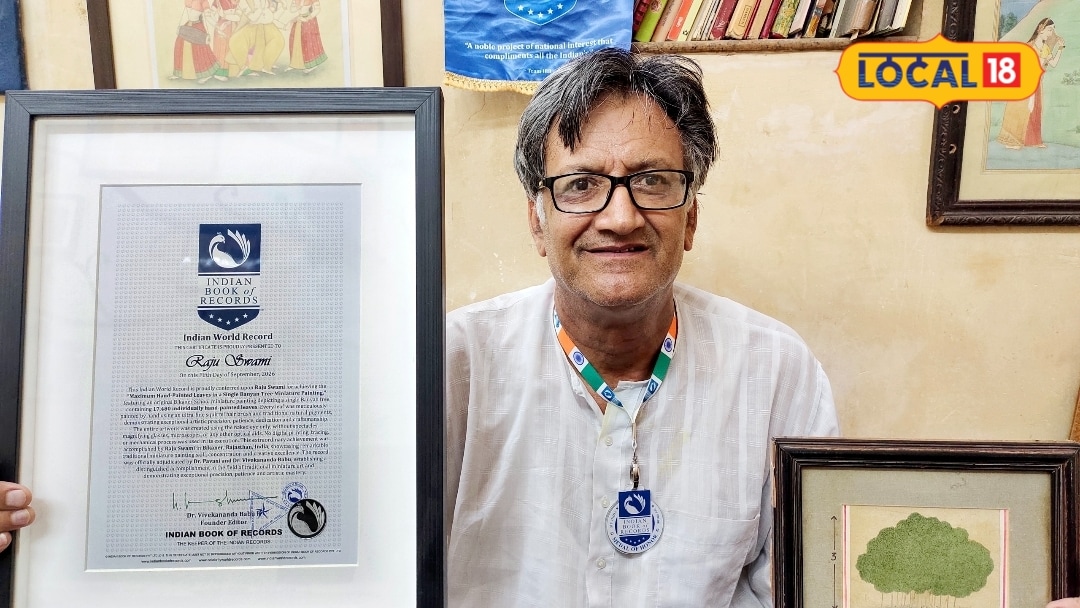
Senior miniature painter Raju Swami, a veteran artist based in Bikaner, has secured a place in the annals of Indian art history by completing a 3 × 4 inch canvas that contains exactly 17,480 individually rendered banyan leaves. The work, finished in 1999, was formally entered into the Indian Book of Records in September 2026, where it received official recognition for its extraordinary precision, use of natural pigments, and the fact that every leaf was painted with a brush fashioned from squirrel hair and applied solely with the unaided eye.
The achievement rests on a long tradition of miniature painting that flourished in Rajasthan during the Mughal era, when artisans were trained to work on extremely small surfaces such as manuscript pages and palace panels. Raju Swami, who began his apprenticeship under a local master in the early 1980s, has spent decades mastering the delicate balance of colour, line and proportion required for such work. His decision to employ only natural dyes—derived from minerals, plant extracts and earth pigments—reflects a conscious effort to preserve the ecological authenticity of the historic craft.
The canvas itself measures a mere three inches by four inches, yet it contains a staggering 17,480 leaf motifs, each rendered with a distinct vein pattern and subtle shading. The artist prepared the pigments by grinding minerals and plant matter into fine powders, mixing them with a binding agent derived from gum arabic. The brush, made from the fine hairs of a squirrel, allowed for strokes thin enough to delineate the intricate venation of each leaf. The entire composition was executed without magnification, relying entirely on the artist’s naked eye, a testament to his visual acuity and disciplined hand control. The finished piece remains in Swami’s personal collection, stored in a climate‑controlled case to prevent deterioration.
While no direct quotations are available, the artist has consistently expressed that the project was intended to demonstrate the limits of human concentration and the enduring relevance of traditional techniques in a digital age. Local art historians have praised the work as a bridge between heritage and contemporary ambition, noting that it showcases the potential of miniature art to engage with modern record‑keeping institutions. Collectors and cultural enthusiasts in the region have shown heightened interest, with several galleries requesting temporary exhibitions of the piece.
The recognition has resonated strongly in the Kotputli‑Behror district, where a growing community of young artisans looks to Swami’s accomplishment as a source of inspiration. Local schools have begun incorporating modules on traditional painting methods, and the district’s cultural council is planning a series of workshops that will teach the preparation of natural pigments and the construction of animal‑hair brushes. The record is expected to attract visitors from across Rajasthan, potentially boosting tourism‑related revenue for small businesses such as handicraft stalls and homestays.
In response to the record, the Rajasthan Department of Art and Culture has issued a formal commendation to Raju Swami and announced plans to document his technique for archival purposes. The Indian Book of Records, having validated the claim, will include the artwork in its upcoming exhibition on Indian micro‑artistry, scheduled for early 2027. Additionally, the district administration of Kotputli‑Behror has pledged financial assistance for a dedicated exhibition space that will house the canvas alongside other regional masterpieces.
Looking ahead, Raju Swami intends to create a series of similarly scaled works that explore other botanical subjects, aiming to push the boundaries of miniature realism even further. The artist is also collaborating with a university research centre to study the longevity of natural pigments under varying environmental conditions. Public expectations are high, as the community anticipates that the forthcoming exhibitions will not only celebrate Swami’s record but also catalyse a renaissance of traditional arts throughout the district.