
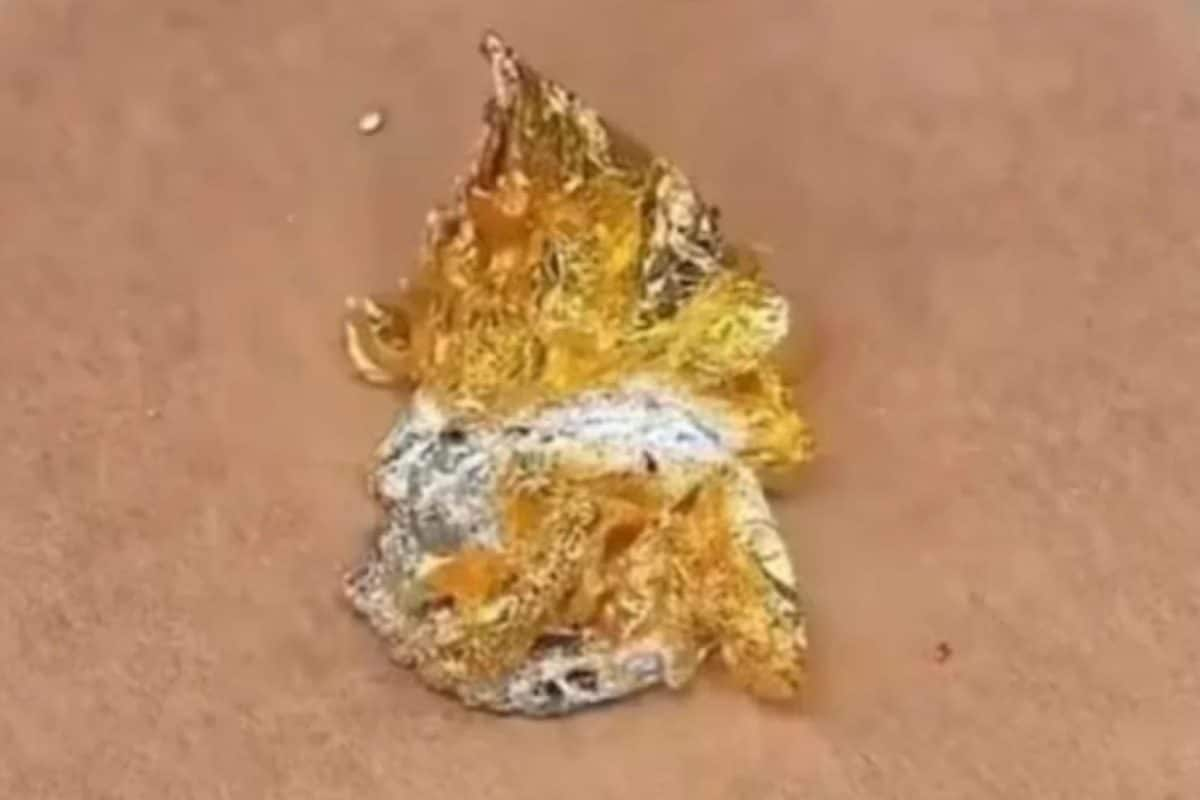
In a development that has captured the attention of researchers and science enthusiasts alike, a scientist from Rajasthan named Lal Bahadur has come forward with a remarkable claim regarding the transformation of mercury into precious metal. Utilizing methodologies and principles derived from ancient Indian texts, the researcher experimented with mercury samples and observed unprecedented metallurgical results. According to the claims made, the surface of the tested mercury sample revealed the presence of 99.04 percent pure gold, bridging ancient alchemy with modern observational curiosity.
The foundation of this experiment reportedly lies in the deep study of ancient Indian manuscripts, which historically documented various metallic transformations and metallurgical techniques. For centuries, traditional scholars have debated the feasibility of alchemical processes described in Sanskrit texts. Lal Bahadur's recent exploration attempts to reinterpret these historical texts through a contemporary scientific lens, raising fundamental questions about ancient technological advancements in chemistry and metallurgy that existed in the subcontinent.
Examining the specifics of the experiment, the reported purity level reaching approximately 99 percent has astonished initial observers. While traditional gold extraction involves rigorous mining and smelting operations, this method focuses entirely on chemical and alchemical manipulation of base elements like mercury. The specific statistic of 99.04 percent purity is the focal point of the current scientific discussions, as even minor deviations in such complex processes usually yield completely different chemical compositions.
As news of this extraordinary claim spreads across scientific circles and general public forums, various stakeholders including academics, independent researchers, and local residents are expressing mixed reactions. While traditionalists view this as a validation of ancient wisdom, mainstream scientists maintain a cautious and empirical stance. The scientific community emphasizes that extraordinary claims require rigorous, peer-reviewed laboratory verification before any historical or economic conclusions can be drawn from such experiments.
Within the regional context of Rajasthan and surrounding areas like Kotputli-Behror, this announcement has generated significant local interest. Local communities and traders are keenly following the developments, discussing the potential implications if such metallurgical techniques could ever be scaled or validated. The cultural pride in ancient Indian heritage is palpable among the residents, who eagerly await official scientific confirmations from premier regional institutions.
To establish the absolute scientific truth behind this phenomenon, formal verification protocols are now being put into motion. Administrative and academic channels are facilitating the next phase of research. It is anticipated that the samples will undergo comprehensive scrutiny at Malaviya National Institute of Technology (MNIT) Jaipur, where advanced spectroscopic and metallurgical instruments will analyze the elemental composition of the treated mercury.
Looking toward the future, the upcoming investigations at MNIT Jaipur will serve as a crucial benchmark for this research. The timeline for these advanced tests is expected to commence shortly, providing clarity to the scientific community and the general public. Whether this experiment will open new doors in metallurgical research or remain a subject of intense academic debate will depend entirely on the rigorous empirical findings delivered by the upcoming laboratory evaluations.
