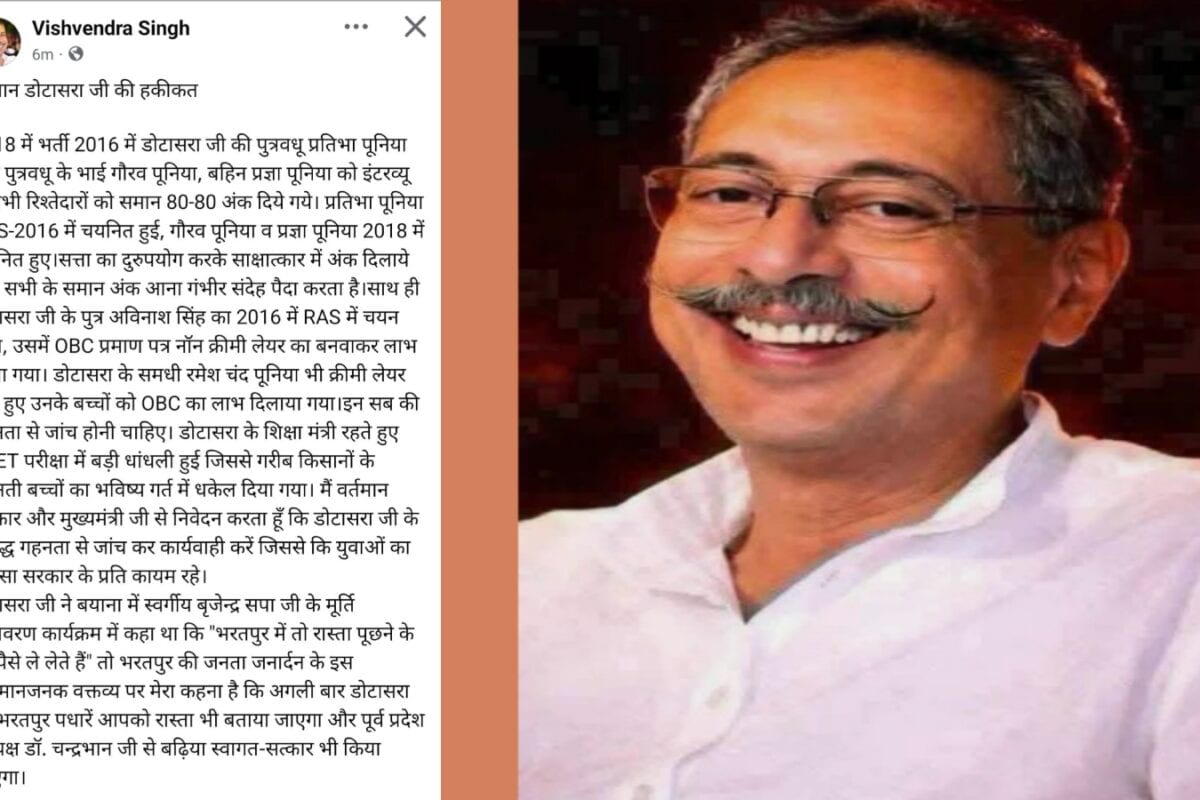
Internal political tensions within the Congress party in Rajasthan have intensified significantly following a strongly-worded social media post by former minister Vishvendra Singh directed at state party president Govind Singh Dotasara. The developments in Bharatpur have brought simmering factional disputes into the public domain, prompting widespread discussions across the political landscape of the state regarding administrative fairness, transparency in governance, and party leadership accountability.
The unfolding controversy traces its roots to historical grievances and contentious administrative decisions from previous years, specifically revolving around high-profile recruitment examinations. Vishvendra Singh has explicitly targeted the selection processes of the Rajasthan Administrative Services for the years 2016 and 2018, demanding rigorous scrutiny into how candidates were evaluated, shortlisted, and ultimately appointed to crucial bureaucratic positions within the state administration.
In his detailed assertions, the former minister also drew attention to critical systemic procedures, including the issuance and verification of Other Backward Classes non-creamy layer certificates, alongside matters pertaining to the Rajasthan Eligibility Examination for Teacher recruitment. These specific examinations and certification processes have historically remained subjects of intense public debate, administrative challenges, and various legal petitions in the state.
The discourse took a sharper turn as Singh questioned the selection of family members and close relatives of Govind Singh Dotasara within these recruitment cycles. By highlighting specific familial connections to official appointments, the former minister sought to challenge the integrity of the selection mechanisms and urged the incumbent Chief Minister to intervene directly and initiate a comprehensive probe into the entire episode to ascertain the absolute truth.
Beyond administrative and recruitment controversies, the political fallout encompasses regional sentiments, particularly concerning Bharatpur. Vishvendra Singh expressed profound indignation over past statements made by the state party president concerning the region, interpreting those remarks as an affront to local pride and dignity. This regional dimension has amplified local resonance, uniting various factions and community members in demanding accountability from top party functionaries.
As demands for a formal administrative inquiry and political accountability echo through various forums, institutional mechanisms face mounting pressure to address these grievances transparently. While the allegations put forward by the former minister carry significant political weight, independent verification of these specific claims remains pending, and they cannot currently be treated as definitive conclusions of any formal judicial or administrative investigation.
Looking ahead, the political trajectory in Rajasthan and specifically within the Congress party depends heavily on how the leadership addresses these internal dissentions and whether formal investigative steps are initiated by the state administration. Observers and citizens alike await official clarifications from the concerned parties, anticipating how this high-stakes political confrontation will influence upcoming organizational strategies and legislative dynamics.