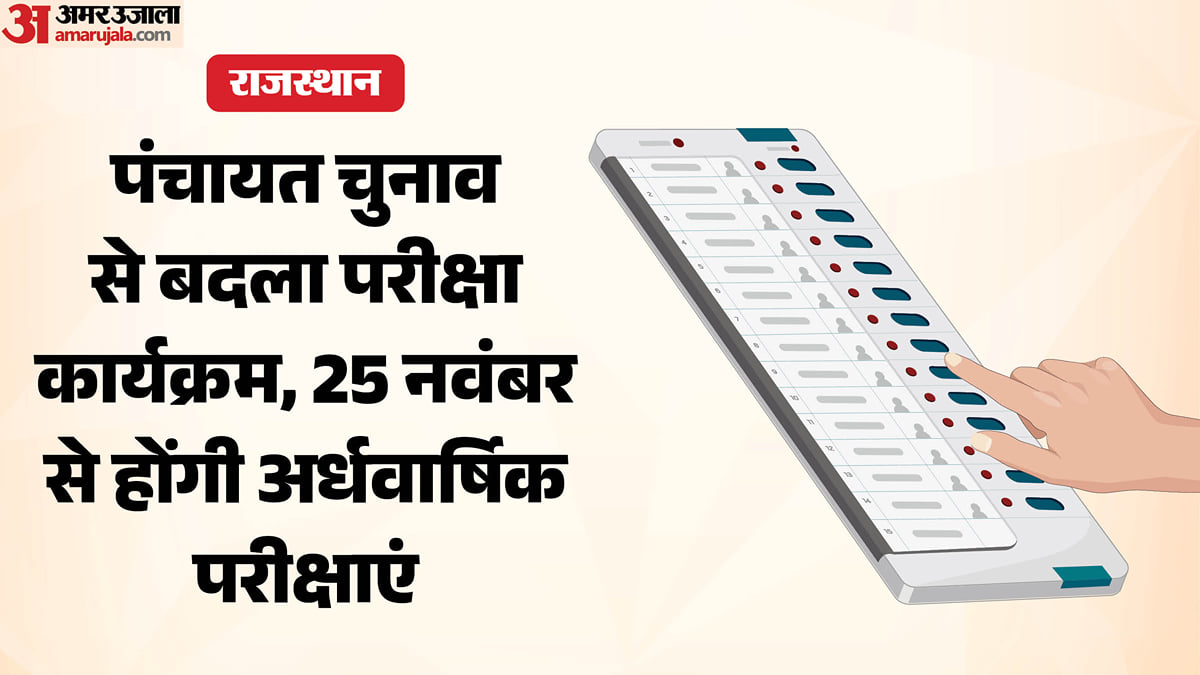
In a major administrative adjustment prompted by the statewide local governance polls, the educational authorities in Rajasthan have officially announced a complete rescheduling of the half-yearly examinations for students enrolled in classes 9 to 12. The revision has become necessary to ensure the smooth conduct of the panchayat elections, which require extensive mobilization of educational infrastructure and teaching staff across various regions of the state. The academic calendar has thus been modified to prevent any direct overlap between critical electoral duties and mandatory school evaluation periods.
The backdrop of this rescheduling lies in the logistical complexity of conducting grassroots democratic elections in a geographically vast state like Rajasthan. Schools frequently serve as primary polling booths, and a significant portion of the teaching faculty is routinely deployed as election officers, booth level officers, and polling supervisors. Consequently, holding examinations concurrently with the election phases would have severely compromised the security, organization, and peaceful environment required for both democratic participation and fair academic assessment.
According to the newly released authoritative notification, the half-yearly examinations for classes 9 through 12 will now officially commence on November 25 and will continue uninterrupted until December 7. This comprehensive window ensures that all secondary and senior secondary subjects are evaluated systematically without exerting undue pressure on the students or educational institutions. The meticulous planning aims to maintain high academic standards while simultaneously fulfilling constitutional obligations regarding rural local body elections.
Educational administrators, school principals, and parent-teacher associations have engaged in extensive discussions regarding the revised dates, emphasizing the necessity of balancing civic responsibilities with student welfare. While sudden changes to the academic calendar traditionally cause minor disruptions in study routines, educational stakeholders have largely welcomed the advance notice, which provides adequate time for teachers and students to readjust their preparation strategies and syllabus completion timelines before November 25.
Within the local context of the Kotputli-Behror region and surrounding districts, educational institutions are currently reviewing their internal infrastructural preparedness to accommodate both the impending election machinery and the rescheduled examination schedules. Local school administrations are coordinating closely with district election officers to ensure that campus facilities are safely transitioned from polling stations back into secure examination halls well before the commencement of tests on November 25.
From an administrative perspective, the state directorate of education continues to monitor the situation closely, issuing detailed operational guidelines to all district education officers to guarantee uniform implementation of the new examination schedule. Strict protocols are being enforced to maintain the integrity of the examination papers, while logistical arrangements for the distribution of question papers and answer booklets are being recalibrated to match the revised December 7 conclusion date.
Looking ahead, parents, students, and school administrators are awaiting the subsequent announcement regarding the junior classes. The education department has clarified that the separate time-table for students in classes 1 to 8 will be released at a later date, once the primary logistical hurdles of the initial election phases are successfully surmounted. Until then, students of classes 9 to 12 have been advised to concentrate fully on their revised preparation schedules leading up to the November 25 kickoff.