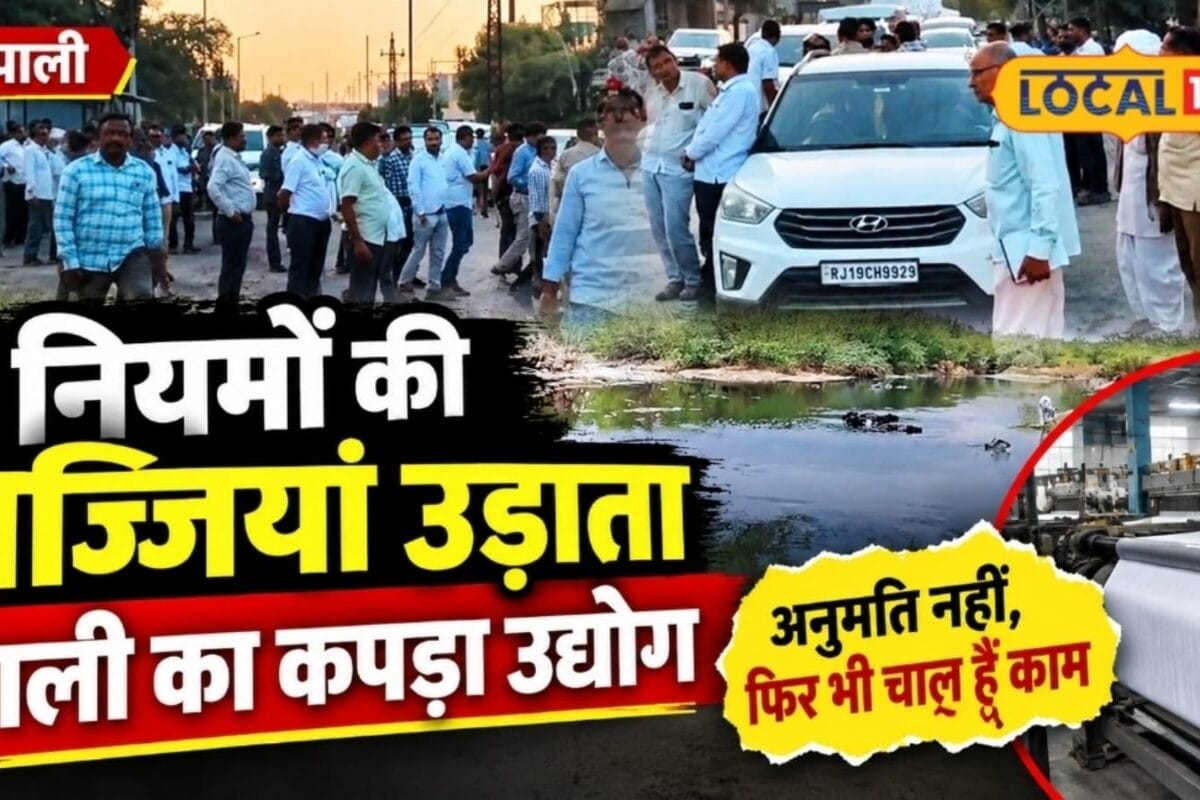
The industrial and environmental crisis in Pali has escalated significantly as monitoring committee chairman and retired justice Sangeet Lodha initiated a rigorous fourth inspection of the region. The primary focus of this extensive administrative tour centered on evaluating the contamination levels of the infamous Bandi River and scrutinizing the operational integrity of local effluent treatment infrastructure. Environmental watchdogs and regulatory bodies have long struggled to curb industrial degradation in this manufacturing hub.
Historical context reveals that industrial wastewater management in the region has faced persistent systemic bottlenecks, affecting both agrarian livelihoods and local ecosystems. Over the years, the rapid proliferation of textile processing units has severely strained environmental capacities, leading to stringent judicial oversight. The current inspection by the monitoring committee serves as a critical checkpoint to evaluate whether industrial stakeholders are complying with mandatory statutory environmental protections.
During the recent inspection tour of CETP-4 and surrounding river segments, startling operational failures came to light regarding industrial capacity and waste management protocols. Local farmers, including Vagaram Vishnoi from Nehra village, raised urgent grievances regarding untreated wastewater overflowing directly into agricultural fields. Furthermore, unauthorized additional tanks constructed near the facility compound have heightened concerns about systematic environmental violations and unmonitored effluent seepage.
Addressing these grave community grievances, retired justice Sangeet Lodha confronted regional officials from the Rajasthan State Pollution Control Board regarding strict non-compliance with paramount Supreme Court orders. The administrative inquiry rigorously questioned CETP Foundation executives concerning plant processing capacities, the operation of unauthorized extra machinery, and the unauthorized intake of chemical-laden wastewater from defaulting manufacturing units.
The broader regional impact of this ongoing ecological crisis extends far beyond immediate industrial zones, directly threatening rural agricultural sustainability and community health across the district. Similar environmental challenges faced in industrial belts throughout the wider region underscore the urgent necessity for transparent resource management and stringent industrial accountability. Agricultural communities continue to bear the heaviest burden of industrial non-compliance, jeopardizing local food security and rural livelihoods.
In response to the alarming discovery of untreated chemical waste being funneled directly into public drainage channels, rapid intervention teams from the Rajasthan State Pollution Control Board initiated immediate field actions. Inspectors collected formal evidentiary samples directly from the contamination points and meticulously sealed the discharge channels for laboratory analysis and subsequent legal proceedings. Such targeted enforcement actions are designed to signal zero tolerance toward systemic environmental negligence.
Looking ahead, administrative authorities and regulatory bodies face mounting public pressure to ensure absolute adherence to environmental standards and plant capacity limits. The failure of the treatment facility to achieve its designated 6 MLD operational capacity remains a critical bottleneck that demands immediate technical remediation. Future oversight procedures will likely involve stringent continuous monitoring, penal actions against defaulting industrial units, and comprehensive ecological restoration plans for the affected river basin.